

How Much Money Can You Get for Suing for Emotional Distress?
Suffering serious injuries in an accident can have lasting effects. This includes not only lasting physical effects, but lasting psychological effects as well. The mental and emotional aftermath of an accident or injury can last for years – if not the rest of the victim’s life.
Similar to post-traumatic stress, pain and suffering, and other forms of non-economic losses, accident victims can seek just compensation under Florida law. The amount that personal injury accident victims can recover depends on the severity of their condition and its impacts on their day-to-day lives.
Understanding Your Claim
Recovering financial compensation for emotional distress is not easy. Not only do you need to prove that you are entitled to financial compensation, but you also need to prove how much you are entitled to recover.
This begins with understanding what constitutes emotional distress under Florida law.
What Constitutes Emotional Distress?
“Emotional distress” is the legal term for the psychological impacts of living through a traumatic accident. Traumatic accidents impact different people in different ways, and some accident victims will suffer far more severe emotional distress than others.
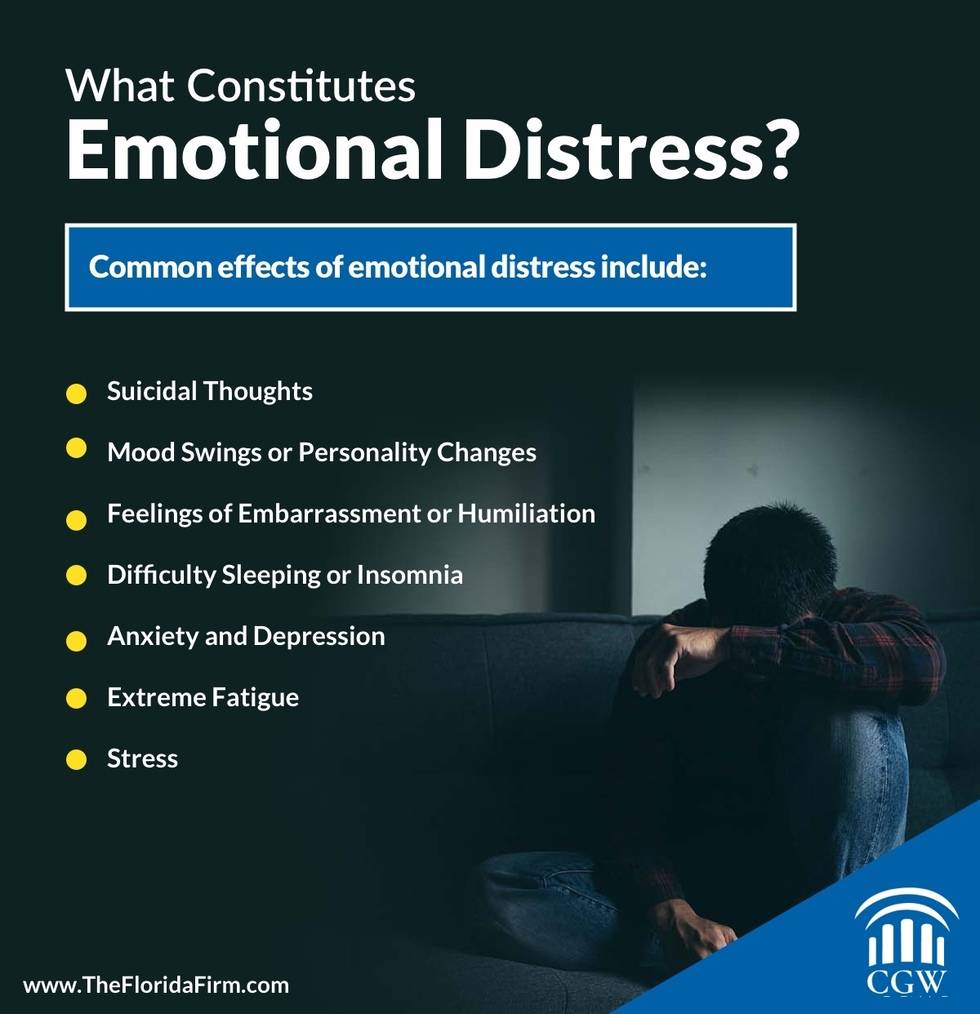
When suffering from emotional distress, accident victims can experience a broad range of effects. Some of the most common effects of emotional distress (also referred to as “mental distress” and “emotional trauma”) include:
- Anxiety and depression
- Difficulty sleeping or insomnia
- Extreme fatigue
- Feelings of embarrassment or humiliation
- Mood swings or personality changes
- Stress
- Suicidal thoughts
Anyone who is experiencing any of these symptoms following a serious accident should seek help promptly. While it can feel difficult – maybe even impossible – to move forward, a doctor who specializes in assisting trauma victims can assist you with getting back to your normal life.
When Can You Seek Financial Compensation?
Under Florida law, trauma victims can seek financial compensation after all types of accidents. If you have been seriously injured under circumstances in which someone else or a company may be to blame, you may be entitled to compensation.
You should discuss your situation with a Florida injury lawyer promptly. This is true for accidents, including:
- Car accidents
- Truck accidents
- Bicycle and pedestrian accidents
- Aviation accidents
- Maritime accidents
- Construction and other job-related accidents
- Accidents caused by defective products
Florida residents can also seek financial compensation in cases of medical malpractice and nursing home neglect. Regardless of what happened, if you are suffering emotionally due to the effects of any form of trauma, you should consult with a lawyer about your legal rights.
How Much Can You Recover for Emotional Distress in Florida?
In terms of the amount of compensation that you may be able to recover, as mentioned above, this depends on your individual circumstances. The amount you can recover depends on the personal losses you’ve incurred.
Of course, unlike the costs of your medical care and your lost wages, you cannot simply “add up” your emotional distress. Additionally, since everyone’s circumstances are different, there is not one specific dollar amount that can be applied.
Instead, calculating just compensation for emotional distress requires a comprehensive assessment and detailed understanding of the effects of your accident. Then, a reasonable compensation award must be determined consistent with Florida law.
Are we talking tens of thousands, hundreds of thousands, or millions of dollars? Again, we really can’t say. All of these are possibilities when justified by the circumstances presented. Once you begin treatment, your lawyer will work with your doctor to assess your claim and determine how much compensation to pursue.
All of this can perhaps seem overwhelming. Right now, all you need to focus on is taking the first step: contacting a lawyer to discuss your legal rights.
An experienced personal injury lawyer can provide individualized legal advice based on your unique circumstances. If you are entitled to financial compensation for emotional distress, your lawyer can do what is necessary to seek a favorable recovery on your behalf.
Is There a Cap on Emotional Distress Settlements?
In most personal injury cases in Florida, like car accidents or slip-and-falls, victims like you can seek unlimited non-economic damages, including emotional distress and trauma. The settlement is still based on the specific impact of the injury. However, medical malpractice cases are treated differently.
State law limits the amount of non-economic damages that a plaintiff can recover in medical malpractice lawsuits under Statutes § 766.118. If the doctors or nurses are the defendant, the money you could get is capped at $500,000 per claimant or $1,000,000 in cases of catastrophic injury or death. Non-practitioner defendants, like hospitals and medical facilities, have a $750,000 limit per claimant with a maximum limit of $1.5 million.
What Is Florida’s Impact Rule?
Beyond damage caps, Florida maintains a unique legal hurdle known as the Impact Rule. Under this legal doctrine, you generally cannot seek compensation for emotional distress unless the negligent action also caused a physical injury. While this rule may make proving emotional distress more difficult, it serves as a threshold to verify that psychological trauma is linked to a real-world event, with a goal to prevent fraudulent or speculative claims.
Types of Emotional Distress Claims in Florida:
There are two primary categories of emotional distress lawsuits in Florida:
Intentional Infliction of Emotional Distress (IIED)
This claim type is used when someone’s deliberate, extreme, and outrageous conduct causes severe mental suffering. The conduct must be so severe that it goes beyond all possible bounds of decency. The Impact Rule generally does not apply to cases involving IIED. Because the defendant’s conduct is intentional, victims are not required to prove a physical impact or physical manifestation of the trauma to pursue a claim. Examples may include violent threats at work or falsely telling someone their loved one has passed away.
Negligent Infliction of Emotional Distress (NIED)
NIED claims occur when someone’s careless or reckless actions cause severe psychological trauma, such as PTSD, anxiety, or depression. This type of claim typically must adhere to the Impact Rule, particularly when a bystander is the claimant. Even if a physical impact occurred, the emotional trauma must typically result in observable physical symptoms, such as a shock-induced illness or a heart attack, to be compensable.
How To Sue for Emotional Distress: Step-By-Step
Knowing how much money you can get through a civil tort lawsuit is just the beginning. Now you need to develop a basic understanding of the step-by-step process for how our legal team would sue for your emotional distress claim. Let us review the core processes, including:
1. Determine the Legal Basis
Determine if your situation meets the strict requirements of one of two Florida legal categories, intentional or negligent emotional distress.
2. Gather Evidence
Florida courts and insurance companies require concrete proof of the event’s psychological impact. You will need to document the severity of your distress and its impact on your daily life. To do this, we use medical and psychiatric records, treatment notes, personal journals, witness testimonies, and employment records.
3. Quantify Damages
You and your legal team will calculate the total value of your claim, which typically combines both economic and non-economic damages (i.e., emotional distress).
4. File a Claim or Lawsuit
Your attorney will present this documentation to the at-fault party’s insurance company. We may also file a formal complaint in civil court, kick-starting the discovery phase. This is where both sides exchange evidence and cross-examine witnesses.
5. Negotiate a Settlement or Go to Trial
The majority of emotional distress claims are settled out of court through negotiations. If an insurance company or the defense fails to offer a fair settlement, your attorney can take your case to trial to have a jury determine liability and damages.
Find Out If You Have an Emotional Distress Claim
It can be difficult to know what constitutes fair compensation after suffering injuries caused by someone else. Your principal concern at this time should be physical and mental recovery, not the complexities of a legal matter.
The personal injury lawyers at The Florida Firm Injury and Accident Lawyers have extensive experience representing people who have been injured through no fault of their own. Our attorneys will fully evaluate the details in your case, including the damages you have suffered, and pursue the full compensation you deserve.
Are you suffering from emotional distress following a serious accident or other traumatic event in Florida? If so, we strongly encourage you to speak with one of our personal injury lawyers in confidence. Please call (407) 712-7300 to schedule a FREE, no-obligation consultation with Colling Gilbert Wright today.